Welcome to Galle |
||
History According to James Emerson Tennent, Galle was the ancient seaport of Tarshish, from which King Solomon drew ivory, peacocks and other valuables. Cinnamon was exported from Sri Lanka as early as 1400 BC and the root of the word itself isHebrew, so Galle may have been a main entrepot for the spice. Galle had been a prominent seaport long before western rule in the country. Persians,Arabs, Greeks, Romans, Malays, Indians, and Chinese were doing business through Galle port. In 1411, the Galle Trilingual Inscription, a stone tablet inscription in three languages,Chinese, Sinhala and Persian, was erected in Galle to commemorate the second visit to Sri Lanka by the Chinese admiral Zheng He. The "modern" history of Galle starts in 1505, when the first Portuguese ship, under Lourenço de Almeida was driven there by a storm. However, the people of the city refused to let the Portuguese enter it, so the Portuguese took it by force. In 1640, the Portuguese had to surrender to the Dutch East India Company. The Dutch built the present Fort in the year 1663. They built a fortified wall, using solid granite, and built three bastions, known as "Sun", "Moon" and "Star". After the British took over the country from the Dutch in the year 1796, they preserved the Fort unchanged, and used it as the administrative centre of Galle. Rumassala kanda in Unawatuna is a large mound-like hill, which forms the eastern protective barrier to the Galle harbour. Local tradition associates this hill with some events of the Ramayana. |
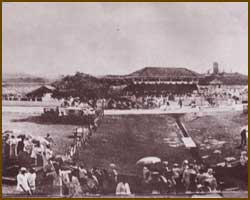 Galle City in 1922 The Legend The Portuguese captured Galle from the Sinhala Kings in 1587 and built a Fort named ‘Santa Crusz” In 1640, the Dutch, with twelve ships under the command of Whilhelm Jacobz Coster laid siege and after four days of severe fighting captured the Fort. The Fort expanded and flourished till 1790 when the British took over Galle. The Galle Fort stands today as a "World Heritage Site’ |
|
